Cleaner Property Appearance
Removing visible overhead conductors on the customer side of the meter produces a cleaner exterior look, particularly on properties with landscaping, additions, or exterior renovations.
Branch Electric provides professional overhead-to-underground electrical service conversions for residential and commercial properties throughout Hamilton County, Marion County, and Central Indiana. Whether you are replacing an aging overhead service, improving the appearance of your property, preparing for a remodel or addition, or coordinating utility and electrical upgrades, our electricians can help plan and complete the electrical work required to transition service from overhead lines to an underground configuration.
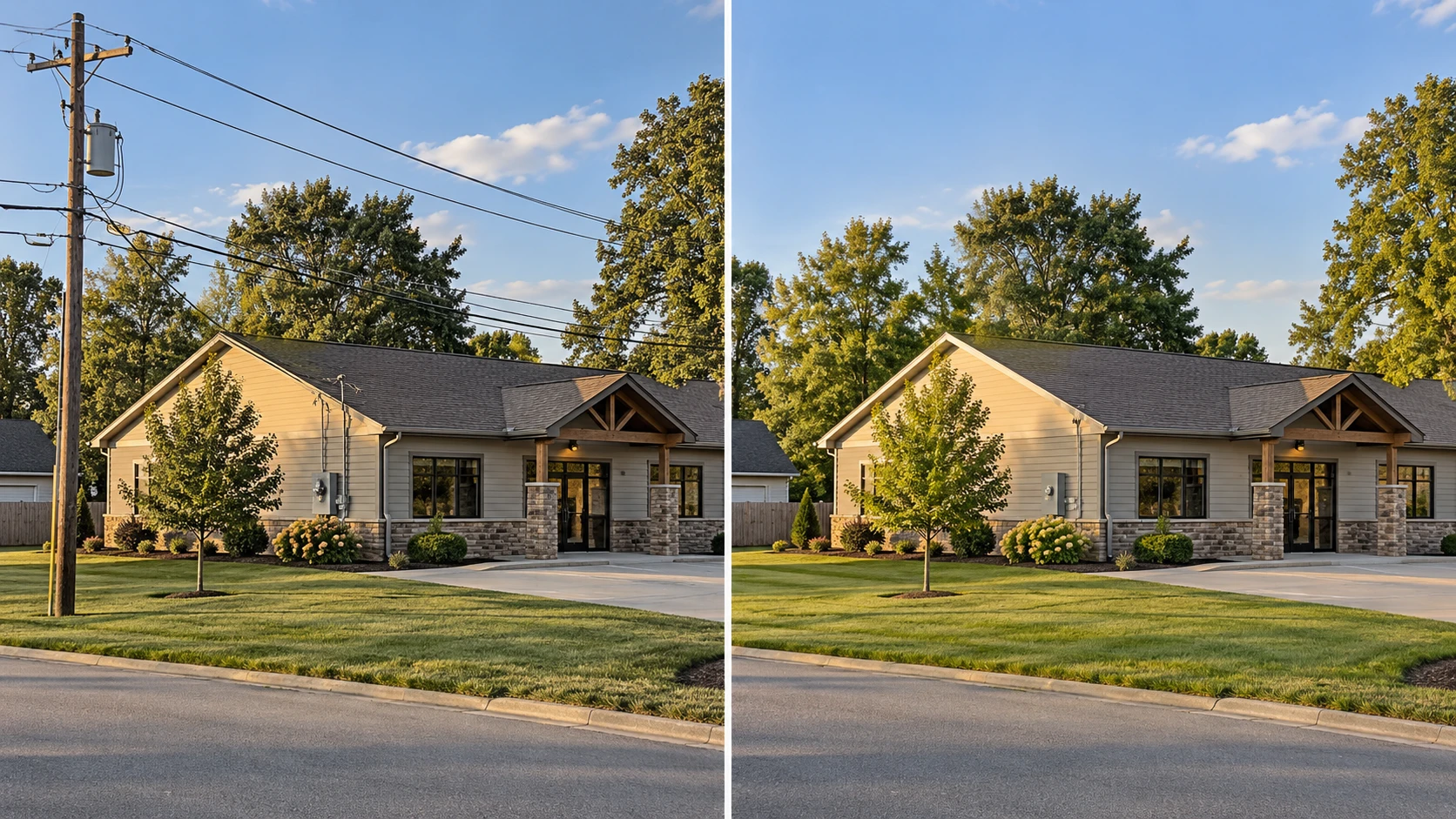
Branch Electric handles the customer-side electrical scope of moving an overhead electrical service to an underground configuration for homes and commercial properties across Central Indiana, Hamilton County, and Marion County.
An overhead-to-underground electrical conversion moves the customer-side electrical service from overhead conductors and service equipment to an underground service configuration, subject to utility, site, permitting, and electrical code requirements. It is a project that involves both electrical work and coordination with the electric utility that serves the property.
An overhead-to-underground conversion is more than replacing a wire. Depending on the property, utility, and project scope, the work can involve utility coordination, changes to meter location and service equipment, new underground conduit and conductors, trenching, panel or service upgrades, grounding and bonding, permits, inspection, and — at the end of the project — a utility disconnect and re-energization.
Not every property is a candidate. The right approach depends on the electric utility serving the address, the local jurisdiction's permitting rules, the existing service configuration, and the site itself. Branch Electric evaluates each project on its own terms.
Property owners consider an overhead-to-underground conversion for a range of practical, aesthetic, and project-driven reasons.
Removing visible overhead conductors on the customer side of the meter produces a cleaner exterior look, particularly on properties with landscaping, additions, or exterior renovations.
Overhead service conductors can interfere with additions, detached garages, second stories, larger vehicles, tree canopy, and site improvements. Moving them underground removes that obstruction.
Older service masts, weatherheads, meter bases, and panels reach the end of their useful life. A conversion can be paired with modern, code-compliant service equipment.
Home additions, garage builds, commercial remodels, and site redevelopment often make an overhead-to-underground conversion a natural part of the larger scope.
On commercial and mixed-use sites, moving the service underground can support a redesigned parking layout, new structures, or an updated site plan.
Underground service supports a cleaner, more intentional site — no service drop across the yard, driveway, or property line.
A note on expectations: underground electrical service is not immune to outages, and it is not maintenance-free. Both overhead and underground systems have their own advantages and considerations. The right choice depends on the property, the utility, and the project.
Homeowners across Central Indiana consider converting from overhead to underground service for a variety of reasons — from replacing aging equipment to opening up the property for future improvements.
Branch Electric supports the customer-side electrical scope of commercial overhead-to-underground conversions for business owners, property managers, developers, and general contractors across Hamilton County, Marion County, and Central Indiana.
Utility distribution engineering and any utility-owned equipment remain the responsibility of the electric utility serving the property. Branch Electric handles the electrical scope on the customer side and coordinates around the utility's requirements.
An overhead-to-underground conversion can create an opportunity — or in some cases a requirement — to address related service equipment at the same time.
Not always. Whether the panel or service equipment must be upgraded depends on the existing electrical system, the current service rating, utility requirements, code conditions, and the scope of the conversion. Some conversions only involve the service route; others are paired with a full panel upgrade or service capacity increase.
Outdated, undersized, or recalled panels can be replaced as part of the conversion so the finished service equipment is modern and code-compliant.
If the project adds significant load — an EV charger, HVAC upgrade, addition, or new commercial equipment — a service capacity increase may be part of the plan.
Meter bases, main disconnects, and exterior service equipment are often replaced or reconfigured during the conversion to match the new underground service.
Grounding electrodes, ground rods, and bonding are updated to current code — often the biggest unseen improvement in a service conversion.
The service entrance conductors are sized to the service rating and the new underground routing, using approved wiring methods.
New breakers, subpanels, or feeder work may be added if the conversion involves reorganizing branch circuits or adding new loads.
Learn more about our electrical panel upgrades and inspections across Central Indiana.
An overhead-to-underground conversion is a coordinated project. The property owner, Branch Electric, the electric utility, the local permitting authority, and — where applicable — an excavation or trenching contractor all have roles.
Owns, engineers, and controls its own service equipment, transformers, and connection point. Sets service rules, approves meter and equipment specifications, and performs the final disconnect and re-energization.
Handles the electrical scope on the customer side of the project — service equipment, panel work, underground conduit and conductors, grounding, permits, and code-compliant installation.
Authorizes the project, coordinates access, approves scope and estimate, and — for commercial projects — sets timelines with the contractor and utility.
The local authority issues the permit and inspects the work. Requirements vary by jurisdiction across Central Indiana.
Utility requirements, connection points, and service rules vary. Branch Electric does not control utility-owned equipment or engineering decisions — we coordinate the customer-side electrical scope around the utility's approved configuration for the property.
Underground service requires more than a conductor and a shovel. Getting the routing right protects the wiring, the property, and every other utility on site.
An underground conversion may require trench planning, approved conduit, correctly sized and rated conductors, separation from other buried utilities, appropriate burial depth, property access, and a plan for restoration of any hardscape, landscaping, or driveway that is disturbed.
Depth requirements are not universal. The correct burial depth depends on the voltage, the wiring method (direct-burial cable, PVC conduit, rigid metal conduit, or other), the utility's own requirements, the local jurisdiction, site conditions, and applicable electrical code. Any project should follow the depth and separation requirements that apply to that specific installation.
Utility locating (calling 811) and coordination with excavation partners are essential before digging. Branch Electric can coordinate the electrical requirements of the underground route and work with the appropriate project partners when excavation is required.
Moving the service underground almost always involves changes to the equipment where the utility service meets the customer's electrical system.
Meter location changes may be possible where the utility, jurisdiction, and site allow. Approved placement is determined by the utility and the applicable code.
New underground service typically calls for a properly rated meter base compatible with the utility's requirements for underground feed.
An exterior main disconnect may be required or advisable depending on jurisdiction, service size, and configuration.
Service entrance conductors are sized and installed to match the new underground configuration and the service rating.
Grounding electrodes, ground rods, and bonding are installed or updated to meet current NEC and local code requirements.
The interior panel is either integrated with the new underground service or replaced entirely, depending on age, condition, and capacity.
Utility requirements often dictate the approved meter equipment, service configuration, and inspection sequence. Branch Electric selects and installs equipment that meets the applicable requirements for the property.
New builds, major additions, and commercial site work are the natural time to plan underground service — the electrical scope integrates with the rest of construction from the start.
Planning underground service early avoids retrofitting later. Learn more about our residential remodeling and commercial build-out electrical services.
Branch Electric partners with general contractors, builders, remodelers, developers, and commercial project managers on projects that involve new service, overhead-to-underground conversion, service equipment, conduit, meter equipment, panel work, utility coordination, and remodel or addition electrical scope.
We coordinate around your schedule, keep clean job sites, communicate directly with the utility and inspector, and finish electrical work that passes inspection the first time.
These are two distinct options — often confused, and each right for a different situation.
Power continues to enter the property overhead. The customer-side equipment — service mast, weatherhead, meter base, service entrance conductors, and panel — is replaced or upgraded while the overall overhead configuration remains in place.
The service route itself changes. Approved conductors are installed underground from the utility's connection arrangement to the property's service equipment — with new conduit, service equipment, grounding, and coordination with the utility.
The best option depends on cost, utility rules, property layout, future construction plans, existing infrastructure, service capacity, and the project goals. Neither is universally better.
A predictable path from first evaluation through utility re-energization.
Review the existing overhead service, panel, meter, property layout, and project goals to define scope.
Determine the applicable utility, permitting, and inspection requirements for the specific property.
Define service equipment, conduit and conductor routing, panel changes, and the customer-side electrical scope.
Coordinate trenching partners, utility work, permits, inspections, and project scheduling.
Complete the approved electrical work — conduit, conductors, service equipment, grounding, and panel work.
Coordinate the required inspection and utility reconnection or re-energization, where applicable.
Utility scheduling, permit timelines, and inspection windows are set by the utility and jurisdiction. Branch Electric coordinates around them but cannot guarantee dates that are controlled by other parties.
A conversion isn't the right choice for every property — but there are common situations where it deserves a serious look.
If your project overlaps with any of the above, an evaluation from a licensed electrician is a good next step.
One contractor to coordinate the service equipment, the underground electrical scope, and the systems that power your property.
Branch Electric handles both residential and commercial electrical work at a professional level — the same team can support a single-family home or a commercial site.
Service entrance work, panel upgrades, meter equipment, grounding, and load planning are core to what we do.
We work the way GCs, builders, and remodelers need trades to work — clear scope, clean sites, and on-schedule installs.
We plan the customer-side underground electrical scope around utility requirements, jurisdiction rules, and site conditions.
Whether the conversion is standalone or part of a larger remodel or new build, we integrate it into the broader construction sequence.
We serve Hamilton County, Marion County, and the surrounding Central Indiana communities — from a home in Zionsville to a commercial site in Greenwood.
Branch Electric serves homeowners, businesses, and contractors throughout Hamilton County, Marion County, and the surrounding Central Indiana communities.
Underground electrical service work across Carmel, Fishers, Noblesville, Westfield, Zionsville, and the surrounding Hamilton County communities — including new construction, remodels, and commercial projects.
Overhead-to-underground conversions across Indianapolis and the surrounding Marion County neighborhoods — including older homes with aging overhead service and commercial site redevelopment.
Underground electrical work throughout the wider Central Indiana service area — including Greenwood, Avon, Plainfield, and surrounding communities.
See our full Branch Electric service areas across Central Indiana.
Clear answers to what property owners, homebuyers, and contractors ask us most about underground electrical service.
In many cases, yes — but not universally. Whether a property can be converted from overhead to underground electrical service depends on the electric utility serving the address, the local jurisdiction's requirements, the existing service configuration, and the site conditions. Branch Electric evaluates each property individually.
A conversion typically involves utility coordination, meter and service equipment changes, new underground conduit and conductors, trenching, grounding and bonding, permits, inspection, and a final utility disconnect and re-energization. The exact scope depends on the property and the utility.
Ownership generally splits between the electric utility and the property owner. The utility owns and controls its own service equipment, transformer, and connection point. The property owner is responsible for the customer-side service equipment, panel, and interior wiring. Branch Electric works on the customer side of the project.
Yes. Overhead-to-underground conversions require coordination with the electric utility that serves the property. The utility sets the requirements for its own equipment, approves the service configuration, and performs the final disconnect and re-energization. Branch Electric coordinates around those requirements.
Not always. Whether a panel or service upgrade is required depends on the existing electrical system, service rating, utility requirements, code conditions, and the project scope. Some conversions only affect the service route; others are paired with a full panel replacement.
Yes. Underground conductors have to be routed below grade, which almost always requires trenching or another approved excavation method. Trench routing, depth, and separation requirements depend on the wiring method, voltage, utility, jurisdiction, and site conditions.
Trenching is often handled by an excavation partner or civil contractor, especially on larger projects. Branch Electric can coordinate the electrical requirements of the underground route and work with the appropriate project partners when excavation is required.
Yes. Branch Electric routinely coordinates with electric utilities on service work, including underground conversions — handling the customer-side electrical scope, service equipment specifications, and inspection sequencing. Final utility engineering, service rules, and equipment on the utility's side are controlled by the utility.
Yes — and it's often the ideal time. Aligning an overhead-to-underground conversion with a remodel or addition lets the electrical work integrate with the broader construction schedule and any site or exterior improvements.
Yes. Branch Electric supports the customer-side electrical scope of commercial overhead-to-underground conversions for offices, retail, mixed-use, light industrial, and redevelopment projects across Central Indiana.
Underground conductors are not exposed to wind, falling limbs, or some overhead hazards. That's a real advantage. But underground systems can still experience faults, excavation damage, water intrusion, equipment failure, or utility-side outages. No electrical service is immune to disruption.
No. Underground electrical systems still require properly installed conduit, conductors, equipment, and connections, and they can require occasional maintenance or repair over time — especially if the system is disturbed by later excavation or site work.
Project timing varies based on utility coordination, permits, inspections, trenching, equipment availability, and the specific electrical scope. Branch Electric provides a project-specific timeline with each estimate rather than a universal number.
Yes. Branch Electric handles underground service work for new residential and commercial construction across Central Indiana, coordinating with builders, GCs, and developers as part of the broader electrical scope.
Branch Electric serves Hamilton County, Marion County, and the surrounding Central Indiana area — including Indianapolis, Carmel, Fishers, Noblesville, Westfield, Zionsville, Greenwood, Avon, and Plainfield.
Call Branch Electric at (463) 210-1544 or request a consultation through branchelectricindy.com/contact-branch-electric. Share the property address, existing service details, and project goals — we'll evaluate the scope and provide a clear estimate.
Whether you're replacing aging overhead service, planning an addition, modernizing your electrical system, or coordinating a commercial project, Branch Electric can help evaluate the electrical scope and guide your overhead-to-underground conversion across Central Indiana.
Branch Electric provides residential and commercial solar electrical services throughout Hamilton County, Marion County, and Central Indiana, including:

Carmel
Fishers
Noblesville
Zionsville
Greenwood
Avon
Plainfield
Surrounding communities
Whether you're replacing aging overhead electrical service, planning an addition, upgrading your electrical system, or preparing a commercial property for redevelopment, Branch Electric can help coordinate the electrical work required for an underground service conversion across Hamilton County, Marion County, and Central Indiana.

Innovation
Fresh, creative solutions.

Integrity
Honesty and transparency.

Excellence
Top-notch services.


Copyright 2025 | Branch Electric | All Rights Reserved